
Defaults in standards rarely apply perfectly in all situations. That’s the case with ASME Y14.5-2018 (Section 4.1, Fundamental Rule ‘S’), which states:
Unless otherwise specified, elements of a surface include surface texture and flaws (e.g., burrs and scratches). All elements of a surface shall be within the applicable specified tolerance zone boundaries.
But what if our surface is an actual granite surface plate?
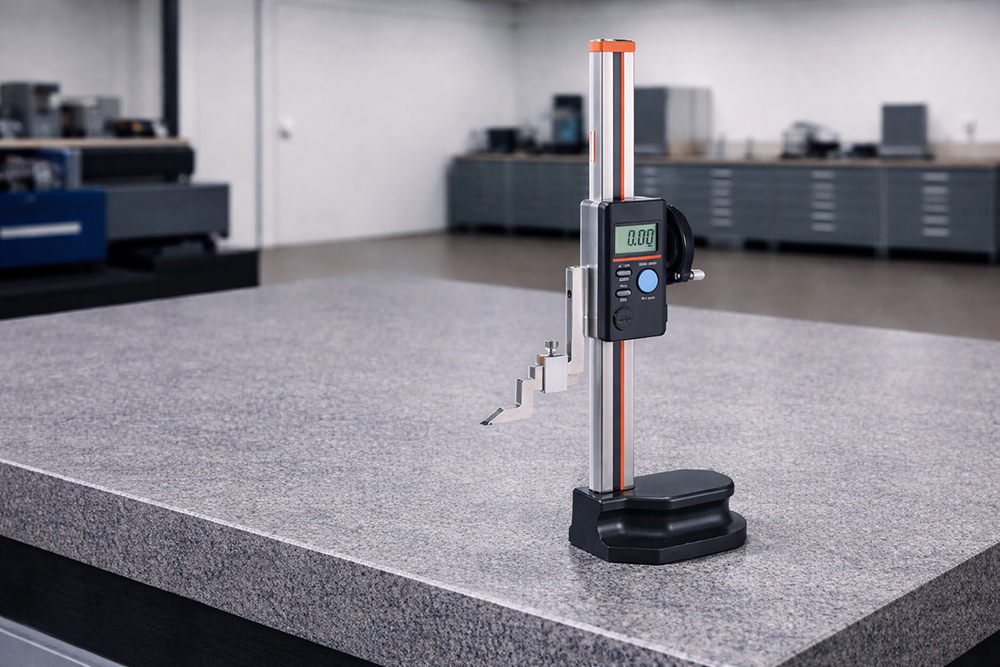
A granite surface plate has a very flat surface that serves as a reference plane for measurement and positioning. But at the finest scales, we can see that the granite can also be comprised of many pits and cracks. These features will not affect the function of the surface plate, however, because the tooling will “bridge” them and rest on the plateau. In fact, some may argue that these features allow for the collection of small debris and can actually help the functionality. So, is it really helpful, or even meaningful, to consider “all elements of the surface” in this case where we are looking to control flatness?
There’s another, very practical challenge that we’d need to address: surface plates can be large. Some are very, very large. If we attempt to measure the entire surface at a resolution that can include surface texture like pits and cracks, our dataset would quickly become unmanageable.
For reference, a typical surface texture measurement using common settings requires collecting data points at a 0.5 µm spacing. Thus, a 0.5 x 0.5 mm area (approximately the tip of a fine mechanical pencil) would require 1,000,000 points if we are looking at surface texture.
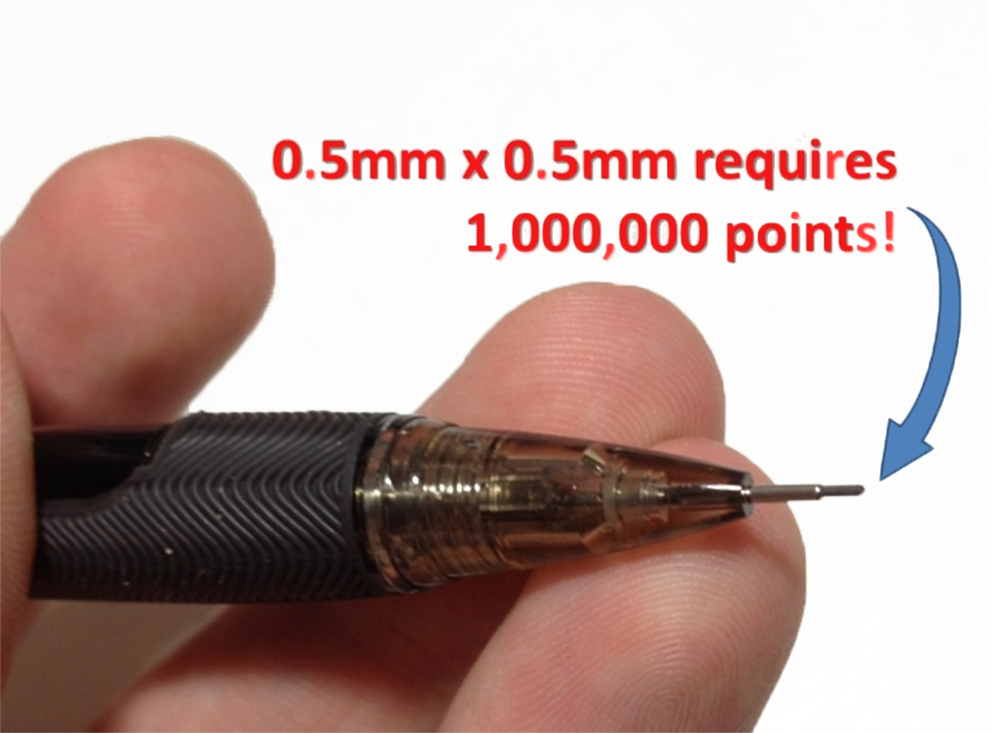
If the tip of a pencil requires a million points, can you imagine how many points it would take to assess flatness on a 6 foot by 3 foot (or a 2000 x 1000 mm table)? The measurement would be far from practical, both in terms of the file size and measurement time.
ASME Y14.49 to the rescue!
ASME Y14.49 provides important tools for specifying a surface like this. First, Y14.49 allows us to specify some amount of filtering to define the “functional surface” (that is, the surface that matters for the particular function). In the case of the granite stand, the base of a height stand will “bridge” features of wavelengths shorter than 50 mm. Therefore, to measure the functional flatness of the table, we might only want to include wavelengths longer than 50 mm.
Using the Y14.49 standard’s supplemental specification frame (SSF) we might create this specification:
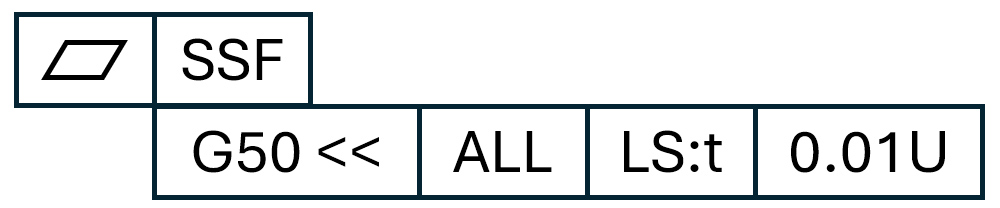
This SSF states that we are controlling flatness considering only wavelengths longer than 50 mm. We will use typical, Gaussian (G) filtering over the entire surface (ALL) to isolate those wavelengths. Within that filtered data, the total peak-to-valley deviation (t) relative to a least squares plane must be less than the 10 µm upper limit.
One immediate benefit of the SSF is that it states that we are only concerned with wavelengths longer than 50 mm in our functional control of flatness. That also tells our quality team that they only need to collect data points at a fine enough resolution to see 50 mm wavelengths – not all the way down to surface texture and flaws.
But wait! With ASME Y14.49 we can do even better!
The above specification provides a much more practical control over the “functional” flatness for a large surface plate. But let’s consider how a surface plate is typically used. In many cases, for actual measurements, the technician is working within a much smaller area of the table. We might therefore need tighter flatness control across smaller areas of the table, perhaps in any 500 x 500 mm area.
ASME Y14.49 gives us a way to add requirements to the SSF, such as a zonal flatness requirement along with the overall requirement:
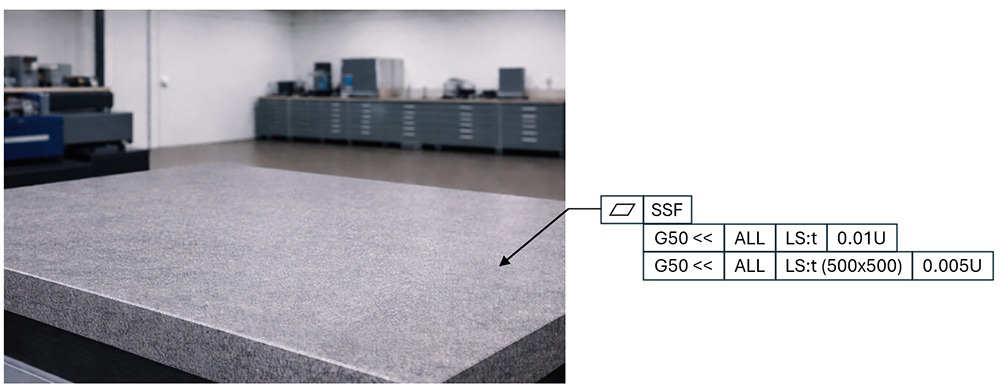
The second line of the SSF indicates the tighter (5 µm) control of flatness over any 500 x 500 mm area. Note: we still indicate “ALL” in that the entire surface plate is subject to this control.
For many of our measurements, the methods in ASME Y14.5 are sufficient to specify and control GD&T quantities. But when we need to define the functional surface more exactly, or we need to remove ambiguity that could lead to misinterpretation or unnecessary measurement complexity, Y14.49 gives us new and powerful tools. It lets us express what matters about the surface and how to measure it as well!
If you have questions on ASME Y14.49, or if you’d like training on this new standard, contact us! We’d be glad to help.