
Mold-Tech created a set of standardized surface textures that can be applied to injection molded parts. The Mold-Tech MT-11010 texture is one of the more common surfaces for appliances, automotive panels, and consumer electronics. It’s a sand-like texture that hides plastic shine, molding defects, fingerprints, and minor dings and damage.
But what makes an MT-11010…an MT-11010? Let’s have a closer look.
“Sand-like”
Mold-Tech surfaces like MT-11010, MT-11020 and MT-11030 are created with bead blasting to provide an overall matte appearance.
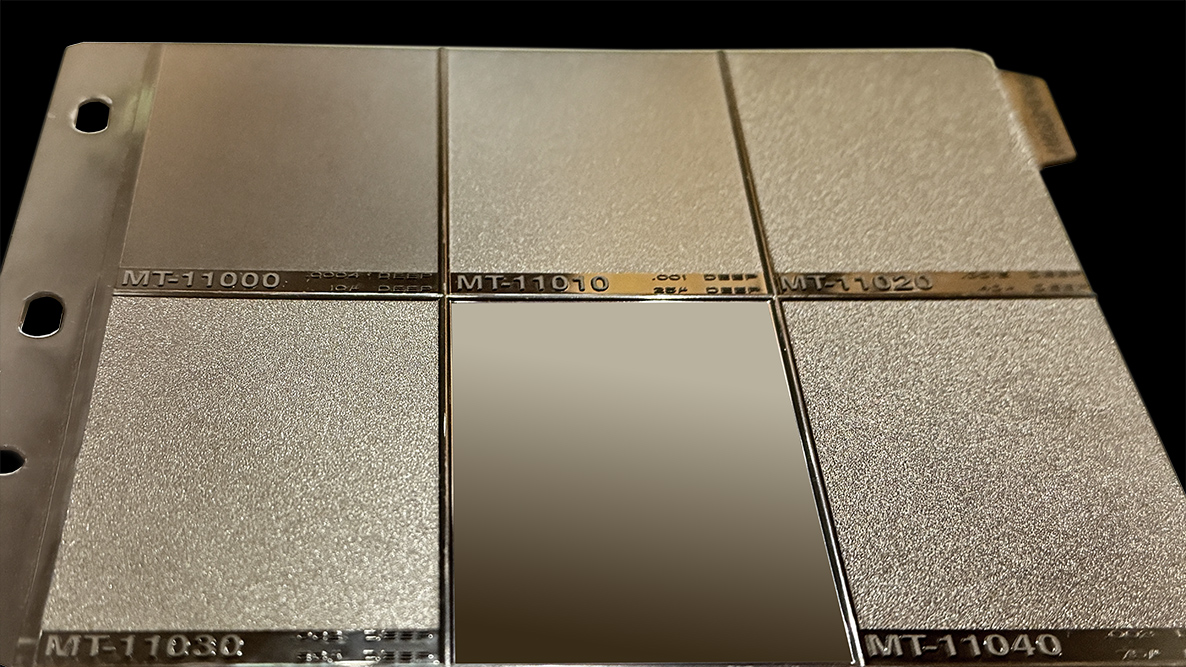
Mold-Tech MT-110XX sand-like finishes.
In the Mold-Tech catalog, MT-11010 is considered a “coarse” finish, with features that are visible to the eye on close inspection. The sand finish is random and intended to hide imperfections. That randomness produces a matte appearance that is a fundamental feature of the MT-11010 texture, and that sets it apart from other finishes with more structured textures.
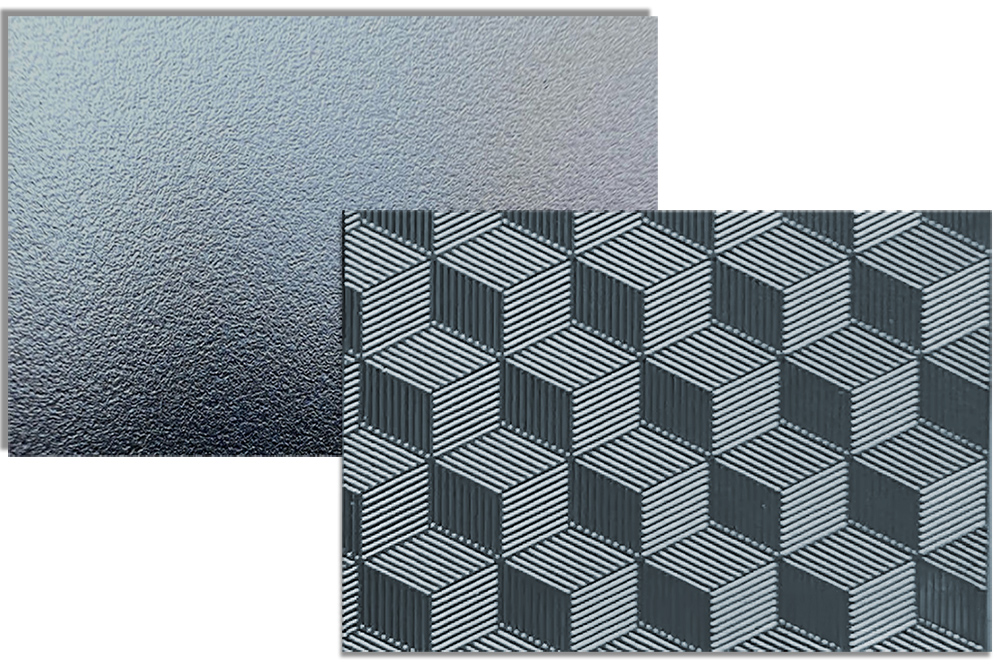
An MT-11010 finish upper (left) produces a matte, random appearance, compared to an MT-11630 finish with a repeated structure (lower right).
Peak heights
The overall height of the texture is another defining characteristic. MT-11010 is one of the finest Mold-Tech “coarse” textures, providing more of a matte finish than any real structure. A more pronounced finish such as an MT-11040 might be preferable in a higher wear location.
A height-based surface texture parameter such as average roughness (Ra, or Sa) is often enough to discern the overall difference between the MT-110XX textures. For example, the MT-11010 finish (Sa = 2.872 µm) and Mold-Tech MT-11040 finish (Sa = 10.159 µm) can be easily distinguished by Sa. However, our eyes can be a lot more discerning, and when it comes to appearance or “visual perception,” average roughness is just a start;. We typically need more than a simple height parameter to describe and control a texture.
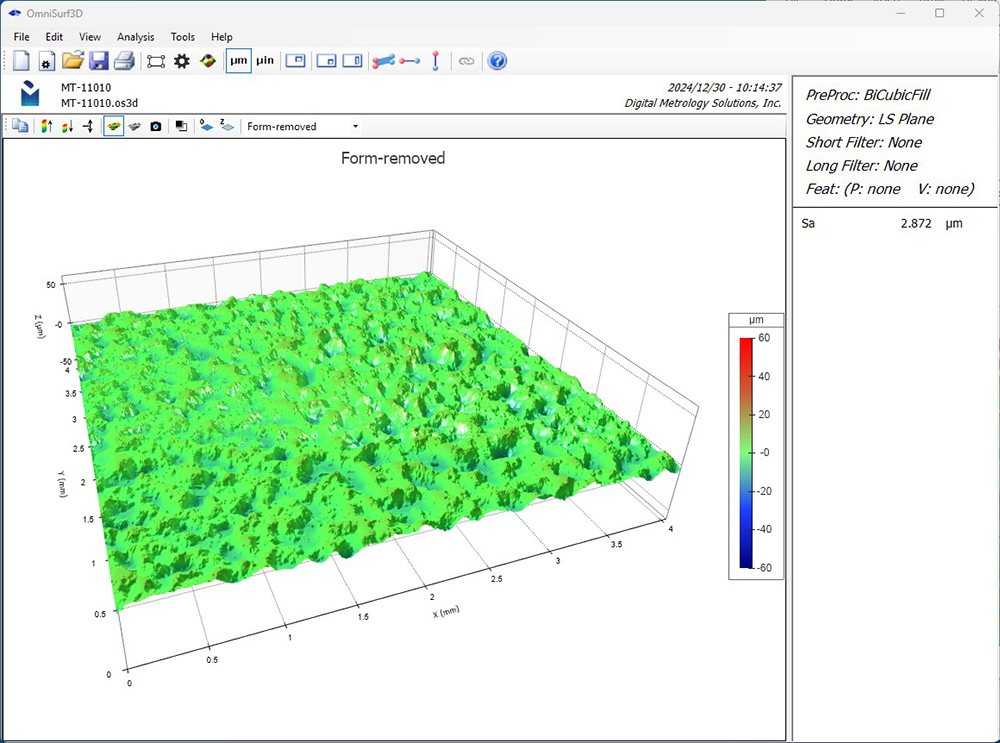
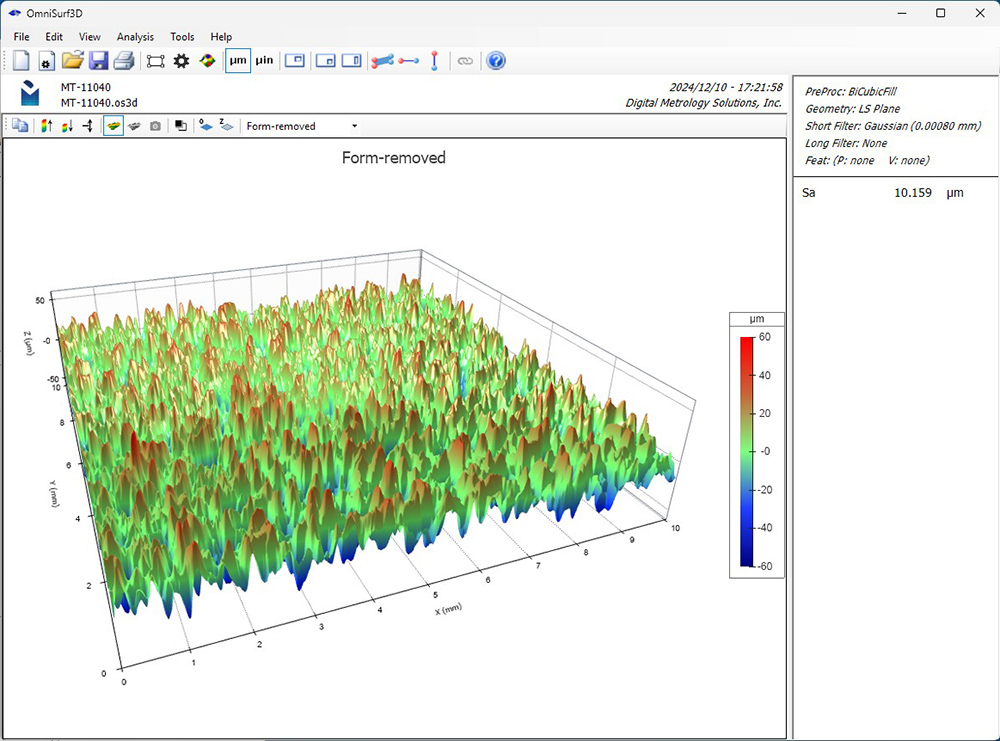
Comparison of average roughness between MT-11010 (Sa = 2.872 µm) and MT-11040 (Sa = 10.159 µm) surface finishes.
Volume of the pits
In some applications such as cylinder bores or print rolls, the volume of fluid that a surface can hold is fundamental to how the surface will perform. In aesthetic surfaces, the exact volume of the pits is not as important as the consistent visual effect they can create. Our eyes tend to equate that consistency with a sense of quality. In particular, the pits can help break up shiny “ghost marks” caused by structural ribs or complex curves. Measuring the pit volume gives a sense of the prominence of the pits in the texture. The images below show the Pit/Porosity analysis in OmniSurf3D for the MT-11010 and MT-11040 finishes. The pit volume of the MT-11010 finish is less than half that of the MT-11040 finish—another defining aspect of the finish.
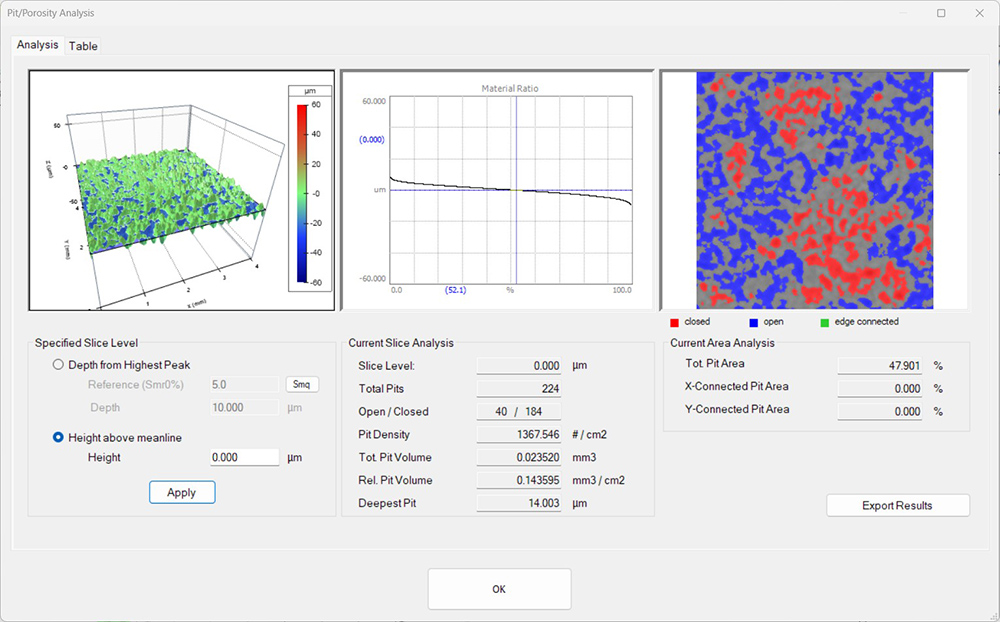
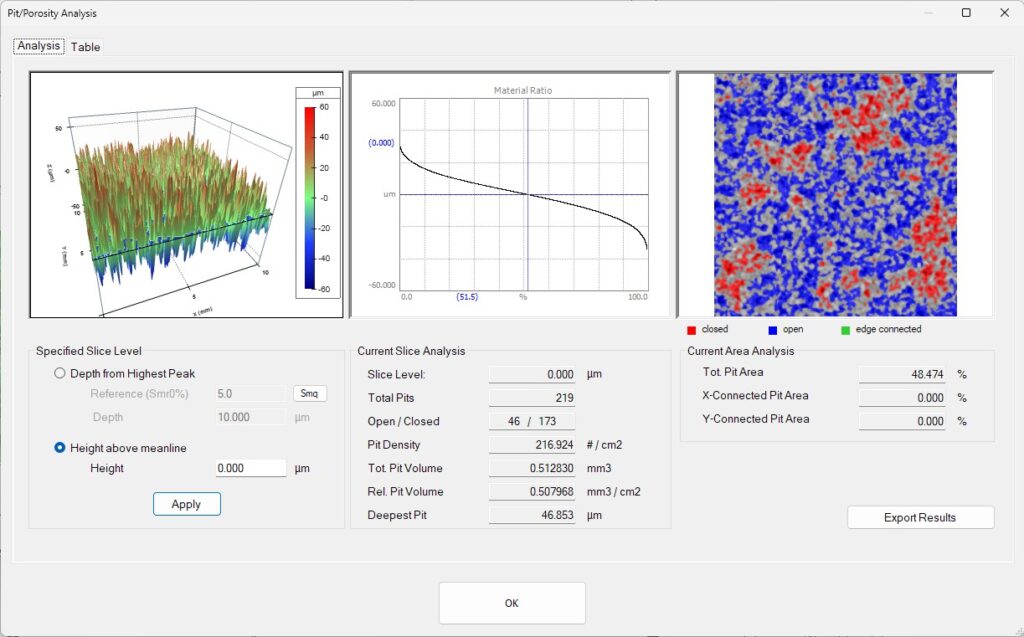
The total pit volume of an MT-11040 texture is double that of an MT-11010 texture.
Diffusion
The reason that the MT-110XX finishes provide an overall matte appearance is that they scatter light in all directions. This aspect of a texture is useful in dashboard finishes, for example, to help keep reflections out of the driver’s eyes in all lighting conditions. Uniform diffusion is also critical for high-end aesthetic finishes, such as phone and computer cases, where consistency reads as quality.
A parameter such as Sdq (Root Mean Square Surface Slope) provides a general measure of surface slopes which can have a dramatic effect on how a surface will reflect/scatter light. The Sdq value for MT-11010 texture, for example is about 7.4° while the Sdq for MT-11040 is 12.5° — a significant difference that helps explain the difference in appearance of these two surfaces.
Did I make a good MT-11010 surface?
Quality control for aesthetic surfaces like MT-11010 is most often done through visual inspection. Any irregularities such as ghost marks, seam lines, or visible misalignment between repeating patterns will catch the eye, so visual assessment is often sufficient.
In some applications, however, we may need to do better than simply looking for macro defects. 3D surface analysis provides parameters like the ones described above to specify and control surfaces numerically, not just qualitatively. OmniSurf3D software provides a vast array of tools and parameters to define textures and to validate that a manufactured texture matches a customer’s expectations. The software also provides visualization tools that let process engineers explore the surface and understand what characteristics need to be controlled to make an aesthetically, and functionally, excellent surface.
Want to learn more about measuring plastic textures with OmniSurf3D? Download a trial version today, then explore the dozens of plastic textures in our free Surface Library, including Mold-Tech Fine and Mold-Tech Coarse, VDI-3400, and SPI textures!