
We spend a lot of time in the world of manufacturing—measuring cylinder walls, additive plastics, and the like. But 3D surface texture analysis goes into so many interesting place…sometimes even back in time!
Dr. Thilina De Silva, an ornithologist and evolutionary biologist, is currently part of a team that’s creating a database of the surface topography of eggshells. The data may reveal correlations between topography and facets of natural history such as diets, habitats, etc. It also has the potential to reveal new understandings about extinct birds and their ecologies and behaviors.
As it turns out, our OmniSurf3D software is the perfect tool for analyzing the data. We caught up with Dr. De Silva to talk to him about the research and how the project is progressing.
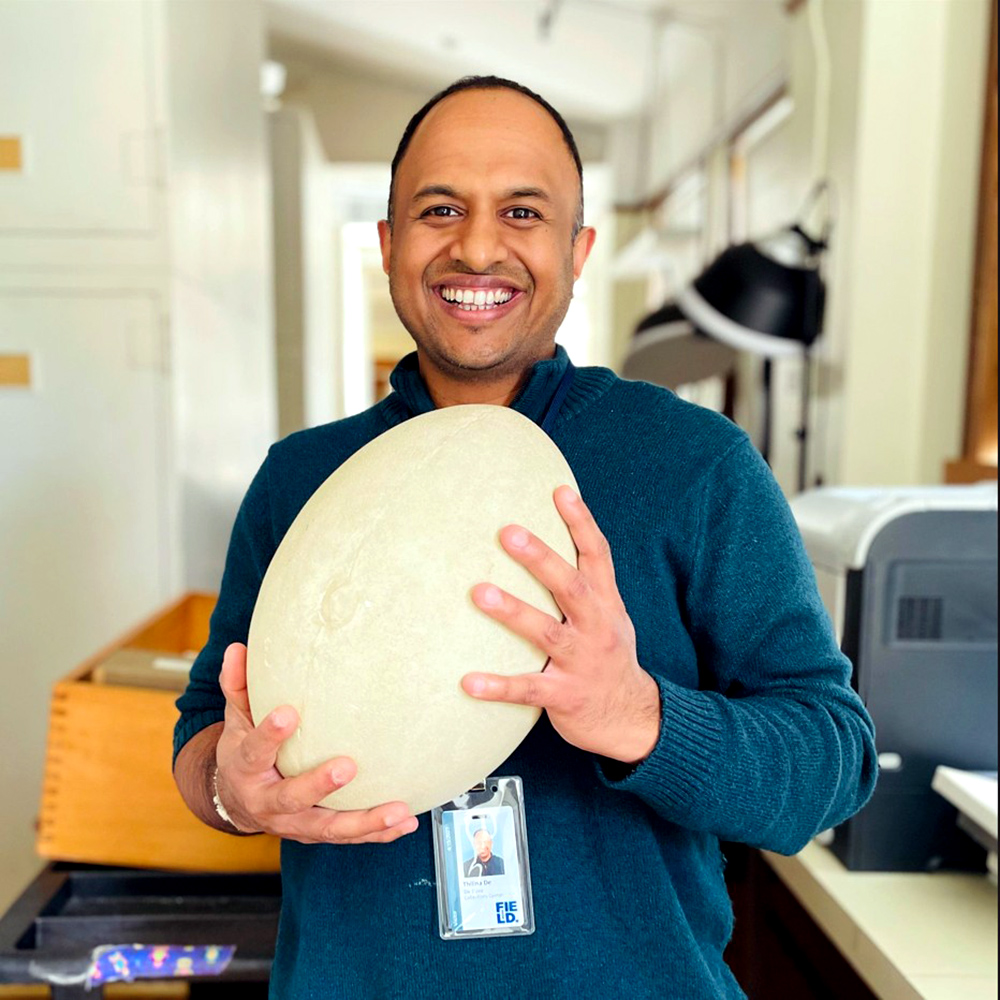
Thilina de Silva with an extinct elephant bird eggshell—the largest egg ever discovered.
What can we learn from eggshells?
De Silva is the principal Investigator at the De Silva Lab of Ecology & Evolution in the Science Research Initiative at the University of Utah. He is participating in the eggshell database project as part of the Stoddard Lab at Princeton University (Also known as “the Eggsplorers”). The project will generate the most comprehensive database of eggshell surface topography that’s ever been undertaken. It’s part of a larger, multi-university project to make available a vast collection of data on living and prehistoric avian species.
According to De Silva, the new data will help researchers map traits for comparative analysis, investigate associations between surface features, bird phenotypes, and natural history, and see how different regions of the eggshell surface evolved.
Previous attempts had shortcomings
Drawing conclusions requires a large body of samples across species—and that data has proven challenging to acquire.
According to De Silva, there have been previous attempts to create a database of eggshell samples, but researchers were limited by the available measurement techniques. Atomic Force Microscopy, for example, requires tiny fragments of eggshells. For obvious reasons, museums are reluctant to subject their valuable collections to such invasive approaches, leaving researchers to rely on tiny, broken fragments to stand in for entire shells, or for entire species!
Better measurement techniques make better data
De Silva’s team is currently using a non-invasive technique to explore eggshell surface topography. Using this method, the team can scan intact eggshells without damage, meaning that large, important collections of egg specimens can now be added to the body of knowledge. “It’s showed us there’s so much diversity to explore,” says De Silva.
The team is also collecting topography data from several regions of each egg, which is shedding light on diversity across a single specimen, as well as across species and evolutionary lineages.
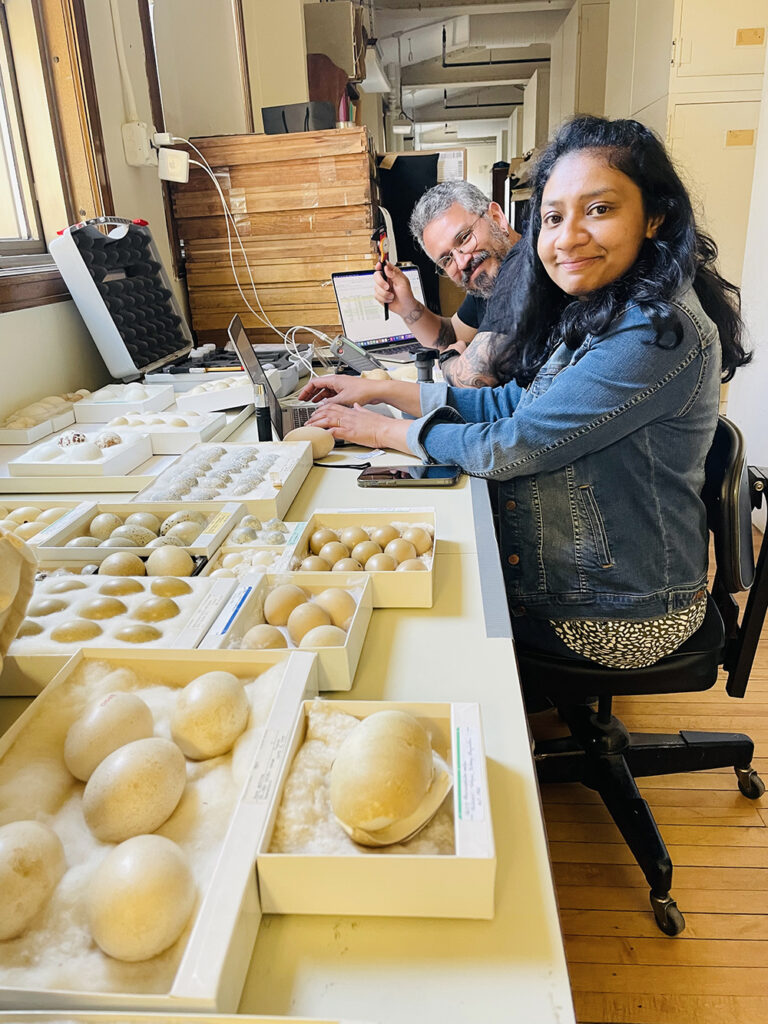
Team members David Ocampo (grad student from Princeton University EEB), and Dr. Sumudu Fernando (postdoc research associate at Princeton University, Stoddard lab) at the Field Museum of Natural History.
OmniSurf3D is the right analysis tool
While new technology made acquisition easier, exploring and interpreting the data is equally important. “We came to Digital Metrology looking into software that can read and analyze the 3D surface topography data,” says De Silva. OmniSurf3D was initially attractive to the team because of its price—a small fraction of similar software packages. As they worked with the software, the researchers found that it was also very easy to learn.
Maybe most important, “OmniSurf3D had all the capabilities that we required,” says De Silva. The team could open data in multiple formats, crop images to remove unwanted data, extract surface metrics such as average roughness, skewness, and kurtosis, and create excellent visuals to support their findings. That combination of affordability, ease of use, and analysis power sold the team on OmniSurf3D.
De Silva also cites the support that he has received as a welcome benefit of the software. “I love the way Mark [Malburg] corresponded. He was very friendly in offering to help, and he was very excited to be part of what we were working on.”
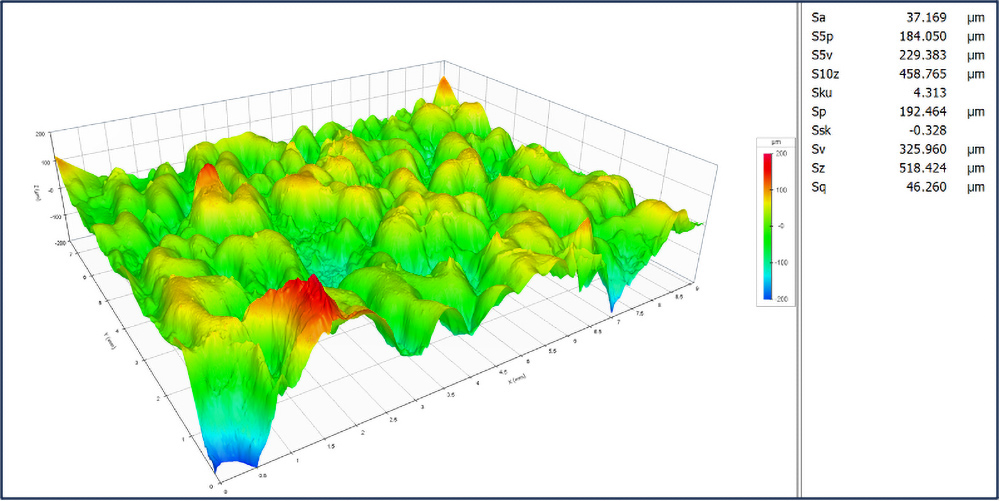
A scan of an emu eggshell as analyzed in OmniSurf3D.
Stay tuned…
The team is currently focused on completing the initial set of data and images, which will then be posted for other researchers to use. While the team knows the data will be used to study diversity in porosity, structure, etc., part of their excitement is in seeing how other researchers will use their data in unexpected ways, to discover new relationships and understandings.
So far, says De Silva, he’s been most surprised by the diversity of topography, even within one sample. “A single piece of eggshell does not necessarily represent the entire eggshell,” he says. The similarities and differences between various regions of shells will potentially spotlight connections across species, and across history.
Stay tuned in the coming months! We’ll be reporting back on the team’s project and findings. If you want to follow along with the project, visit I don’t have content right now. But we recently started a lab webpage: www.thilinadesilva.com.